Is Physics Approaching the End of the ‘Particle Era’?
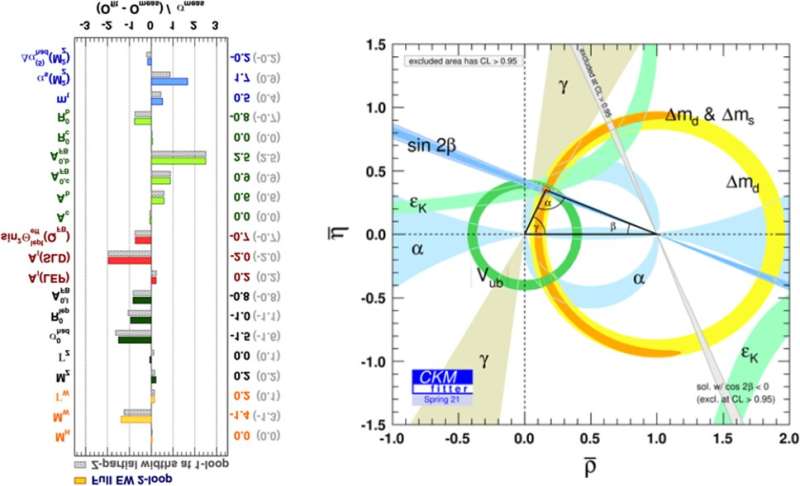
In 2012, the momentous discovery of the Higgs Boson marked a significant milestone in particle physics, completing what is known as the standard model. However, despite this achievement, the standard model falls short in addressing all the questions in physics. Since the groundbreaking discovery at the Large Hadron Collider (LHC), physicists have been on the quest for new physics beyond the standard model, exploring the potential shape of future breakthroughs.
A recent paper published in The European Physical Journal H by Robert Harlander, Jean-Philippe Martinez from the Institute for Theoretical Particle Physics and Cosmology, RWTH Aachen University, Germany, and Gregor Schiemann from the Faculty of Humanities and Cultural Studies, Bergische Universität Wuppertal, Germany, delves into the notion that particle physics may be standing on the brink of a new era of understanding and discovery within the field. The paper also contemplates the various scenarios that might shape the future of high-energy physics.
Martinez emphasized the profound role of the concept of particles in physics over the last century. It has evolved over time, opening up novel avenues for particle observation and facilitating the discovery of new particles. Presently, the observation of a particle necessitates its “on-shell” production, meaning that its mass, energy, and momentum must adhere to a specific relationship (E²=m²c²+p²c⁴). Essentially, for the discovery of a new particle, it must be on-shell during the experiment, even if only momentarily.
The paper proposes that new particles could potentially be too heavy for on-shell production, thereby pushing particle physics towards another transformative phase in particle observation and, quite possibly, in redefining the concept of particles themselves.
Martinez highlights that particle physics is currently at a unique juncture. It forces us to confront the possibility that the age of particle discoveries, as we currently know them, might be drawing to a close. The authors assert that particle physics has undergone several evolutionary steps in the past and suggest that the next paradigm shift could be imminent. However, they anticipate that such a transformation will likely emerge from within particle physics itself, as it has in the past.


많이 본 기사
 1US Navy SSN(X) Attack Sub to Be Undersea Drone Mothership
 2After NVIDIA Exit, Is Jensen Huang Headed to Musk’s SpaceX?
 3Jensen Huang Resigns as NVIDIA CEO, Ending the Founder Era
 4PsiQuantum, AMD Co-Design Classical Layer for Fault-Tolerant Quantum
 5Google DeepMind’s AlphaGenome 2 Predicts DNA Variant Effects by Cell Type