Voyager 1 Reaches One Light-Day From Earth, a First for Any Human-Made Object
Voyager 1 reaches the ‘one light-day’ point, 16.094 billion miles (about 25.902 billion km) from Earth, at 7:16:07 p.m. Korea time on November 18 (2:16:07 a.m. U.S. Pacific Standard Time), according to the U.S. National Aeronautics and Space Administration (NASA). It is a distance that takes light a full day to cover, and the first time a human-made object has reached it.
A light-day is the distance light travels in a vacuum in one day. NASA explained that at this point “it takes 24 hours for light sent from Earth to reach the spacecraft.” This means a command sent from Earth takes a day to reach Voyager 1, and a reply takes another day to come back. Suzanne Dodd, Voyager project manager at NASA’s Jet Propulsion Laboratory (JPL), said, “We wait two days to get a response.”
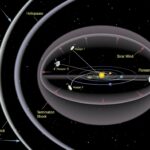
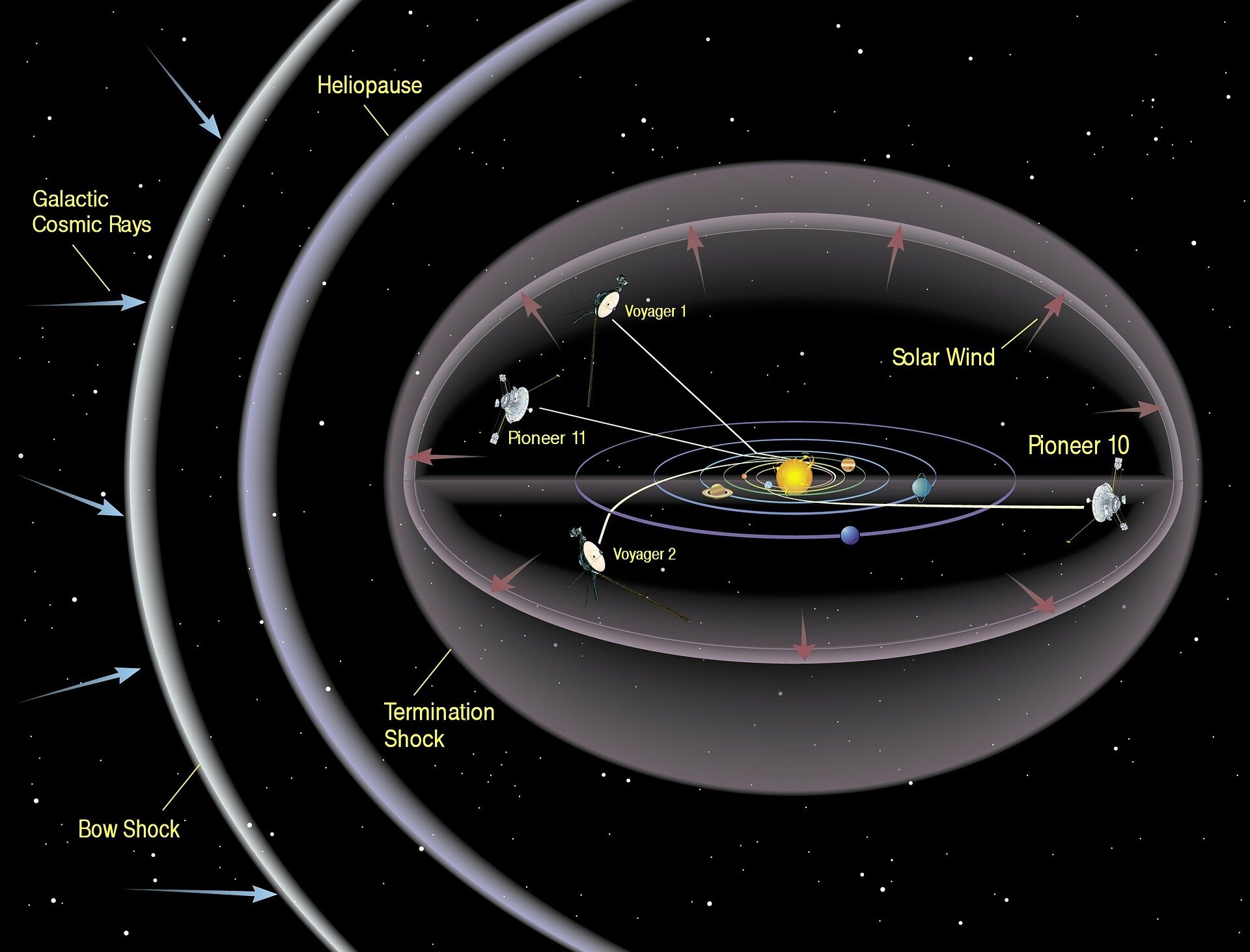
Launched in 1977, Voyager 1 flew past Jupiter in 1979 and Saturn in 1980 before heading toward the outer solar system. In 2012 it crossed the heliopause, the boundary of the solar wind’s reach, and entered interstellar space (the space between stars); its twin probe, Voyager 2, followed in 2018. NASA emphasizes that the two Voyagers are “the only spacecraft to have operated outside the heliosphere.” Voyager 1 is currently moving away at about 61,000 km per hour (about 38,000 miles per hour).
The probe’s condition is not easy. The output of its nuclear power source declines by about 4 W every year, and NASA has been switching off instruments one by one. Of the 10 instruments on board at launch, only two remain on aboard Voyager 1: the magnetometer (MAG) and the plasma wave subsystem (PWS). The low-energy charged particles instrument was turned off on April 17, 2026. On October 18–19, communication was lost twice before the signal was restored on October 20.
Communication with Voyager 1 is expected to continue until the early 2030s. Even after that, the probe will keep flying, carrying the ‘Golden Record’ with sounds and images of Earth. Linda Spilker, Voyager project scientist at JPL, has said that once communication ends, those records will become “our silent ambassadors.”
To mark the milestone, NASA will hold a panel discussion at JPL at noon U.S. Eastern Time on November 19 (2 a.m. Korea time on the 20th), with participants including Nicky Fox, associate administrator of NASA’s Science Mission Directorate, and will stream it online. This article will be updated once details from the event are available.
One light-day is a symbolic record that, for the first time, extends the range of human exploration to a full day measured in ‘light time.’ At the same time, the operational techniques that keep a 49-year-old probe running through power management, and the long-distance communication that accepts a day-long command delay, are experience that carries directly into the design of future outer-planet and interstellar missions.
| Instrument | Voyager 1 | Voyager 2 |
|---|---|---|
| Cosmic Ray Subsystem (CRS) | Off to save power (Feb. 25, 2025) | On |
| Low-Energy Charged Particles (LECP) | Off to save power (April 17, 2026) | Off to save power (March 24, 2025) |
| Magnetometer (MAG) | On | On |
| Plasma Wave Subsystem (PWS) | On | On |
| Plasma Science (PLS) | Off because of degraded performance (Feb. 1, 2007) | Off to save power (Sept. 26, 2024) |
| Imaging Science Subsystem (ISS) | Wide-angle and narrow-angle cameras off to save power (Feb. 14, 1990) | Wide-angle and narrow angle cameras off to save power (Oct. 10 and Dec. 5, 1989) |
| Infrared Interferometer Spectrometer and Radiometer (IRIS) | Off to save power (June 3, 1998) | Off to save power (Feb. 1, 2007) |
| Photopolarimeter Subsystem (PPS) | Off because of degraded performance (Jan. 29, 1980) | Off because of degraded performance (April 3, 1991) |
| Planetary Radio Astronomy (PRA) | Off to save power (Jan. 15, 2008) | Off to save power (Feb. 21, 2008) |
| Ultraviolet Spectrometer (UVS) | Off to save power (April 19, 2016) | Off to save power (Nov. 12, 1998) |
Updated April 17, 2026
Sources: NASA, Where Are Voyager 1 and Voyager 2 Now? · NASA one light-day event announcement (2026-11-10, updated 11-13) · EarthSky (2026-11-17)
Related articles
- NASA’s Lucy enters Jupiter’s Trojan asteroid swarm five years after launch, first close observation in 2027 (in Korean)
- The ‘unknown’ alien data sent by NASA’s Voyager 1 (in Korean)
- SpaceX catches Starship upper stage with ‘chopsticks’ for the first time; Super Heavy booster recovery fails (in Korean)