Naval Shipbuilding Up 50%: China Builds 636,000t, U.S. 271,000t
According to the report ‘World Defense Shipbuilding 2026,’ released ahead of the opening of Euronaval 2026, the value of warships built worldwide in 2024-2025 was about $122 billion to $124 billion, a sharp increase from the previous two years. Of this, combatant ships built by China totaled 636,208 tons, more than double the 270,509 tons built by the United States. We examine both what the figures mean and their limits.
What the report’s numbers say
The report’s data were compiled jointly by Flottes de Combat and Gican, the French maritime industry association. Global combatant ship construction in 2024-2025 reached 1.47 million tons, up sharply from 959,671 tons in the previous two years. Construction value was $123.9 billion, more than the $81.8 billion of the previous two years. The report states that military and paramilitary shipbuilding grew 50% in two years to reach $122 billion.
By country, China built 636,208 tons (about $43.5 billion) and the U.S. 270,509 tons (about $26.8 billion). They were followed by Russia with 149,056 tons, India with 76,430 tons and Italy with 53,700 tons, while Türkiye, France, Japan, South Korea and Romania rounded out the top 10. China’s share exceeds one-third of global combatant tonnage.
China pulls ahead of the U.S.
The ranking flipped in two years. Figures from the previous edition (2022-2023) cited by Defense News put China at 202,520 tons and the U.S. at 245,703 tons, with the U.S. ahead. Naval News also reported ship delivery figures. In 2024-2025, the Chinese People’s Liberation Army Navy (PLAN) took delivery of nine nuclear-powered attack submarines (SSNs) and 10 destroyers, while the U.S. Navy received three SSNs and four destroyers. Global SSN production rose from six in 2022-2023 to 17 in 2024-2025, with $27.3 billion invested. Deliveries of conventional submarines rose from 11 to 18.
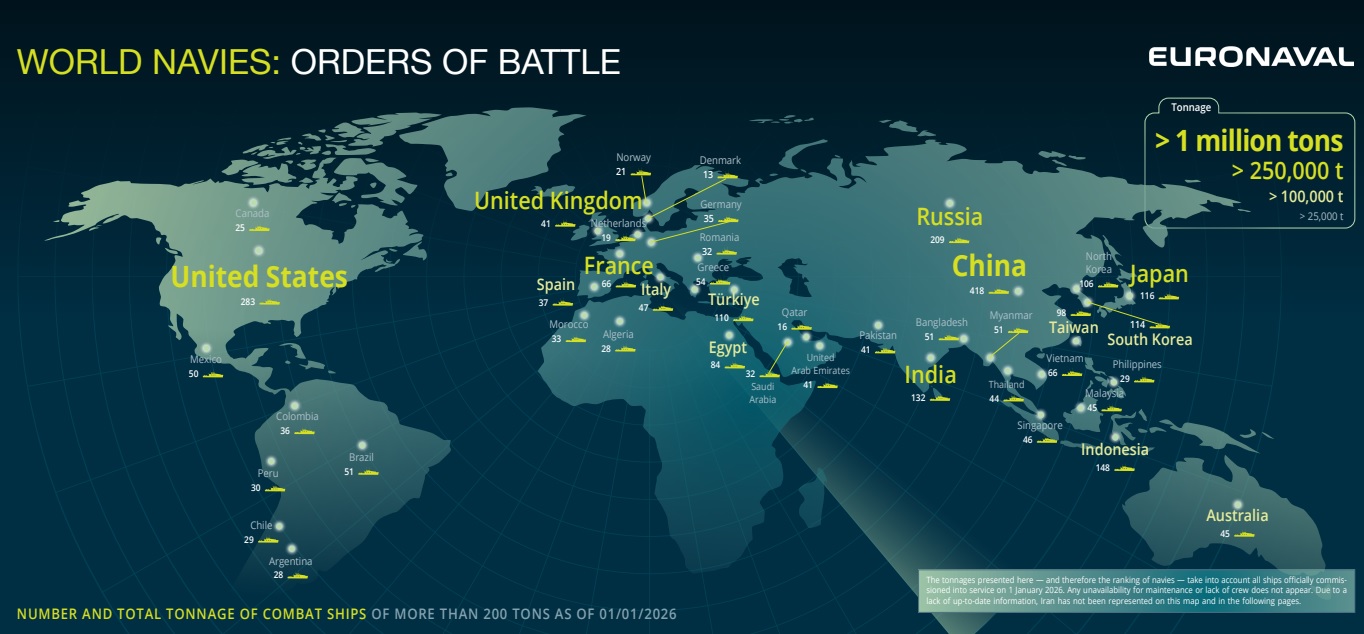
The size of the fleets actually in service is a different story, however. As of Jan. 1, 2026, the total tonnage of vessels over 200 tons was 3.11 million tons for the U.S. and 1.44 million tons for China, so the U.S. fleet is still larger. But compared with two years earlier, when the U.S. had 3.22 million tons and China 1.3 million tons, the U.S. figure has fallen and China’s has risen, narrowing the gap.
What tonnage doesn’t tell you
Tonnage is only a measure of shipbuilding output; it does not denote combat power. The increase includes expensive, advanced assets such as nuclear-powered attack submarines, so it is difficult to compare relative strength by tonnage alone. The report does not disclose in detail exactly how it defines “combatant ships” or how it counts tonnage. The 2022-2023 comparison figures come from the previous edition and may have been compiled differently, and the construction data run through December 2025 and the fleet data through Jan. 1, 2026. In addition, the figures compiled by the report’s authors have not been independently verified.
Even so, the direction is clear. Philippe Missoffe, director general of Gican, said he sees a significant expansion of naval power and a corresponding expansion of shipbuilding. Military media have also described it as an “unprecedented boom,” reporting the conclusion that the era of expeditionary crisis management is over. This means a race to build more warships, faster, is under way in several countries at once. South Korea is also among the top 10.
In sum, global warship construction in 2024-2025 totaled 1.47 million tons, with China accounting for more than one-third of the world total at 636,208 tons and the U.S. at 270,509 tons. Nuclear-powered attack submarines rose from six to 17, and conventional submarines from 11 to 18. In total fleet tonnage, the U.S., at 3.11 million tons, is still more than twice the size of China, at 1.44 million tons, but the gap has narrowed compared with two years ago. Today’s numbers are indicators of shipbuilding output and fleet size; an actual comparison of naval power requires separate analysis.
Why it matters
Warship construction capacity is the industrial base that underpins naval power. This report shows that output grew substantially in two years. However, the report’s figures do not directly indicate superiority in combat power, and the parts of its methodology that have not been disclosed need to be verified.
Source: World Defense Shipbuilding 2026
Related articles
- Hanwha Philly Shipyard Wins $269M US Navy Landing Ship Order
- HD Hyundai and Kiewit launch U.S. shipyard joint venture ‘HD Kiewit Shipbuilding’… construction to start in 2027, operations in 2029 (in Korean)
- [Analysis] U.S. House says Seoul-Beijing ties “harm national interests”… what it means for MASGA, the Korea-U.S. shipbuilding cooperation initiative (in Korean)
This article was translated from the Korean edition of Science Monitor with AI assistance and reviewed by our editors.