India signs deal for 8 next-generation corvettes from GRSE, GSL
India’s Ministry of Defence signed a contract on November 2 to build eight Next Generation Corvettes (NGC, multi-role warships smaller than frigates). The total value is about 53,866.5 crore rupees (1 crore = 10 million), and two Indian state-owned shipyards will split the work.
Garden Reach Shipbuilders & Engineers (GRSE) will build five ships for about 32,000 crore rupees, and Goa Shipyard Limited (GSL) will build the remaining three. The program began in 2016 with a requirement for seven ships, and the Defence Acquisition Council (DAC) raised it to eight in June 2022. The Cabinet Committee on Security (CCS) approved the program on October 28, 2026. In other words, it took 10 years to go from the initial requirement to a contract.
India’s arms procurement goes through several stages. The Defence Acquisition Council (DAC) is the weapons procurement approval body led by the defence minister, and the Cabinet Committee on Security (CCS), chaired by the prime minister, is the highest decision-making body on security matters. The Next Generation Corvette program had its ship count increased by the DAC in 2022, and after CCS approval in October this year, the contract was signed within a week. A long-delayed program moved quickly in its final stage.
The schedule calls for the first launch in late 2029 and deliveries starting in 2031. Naval News cited photos of the signing ceremony released by the Indian Ministry of Defence and a GRSE press release.
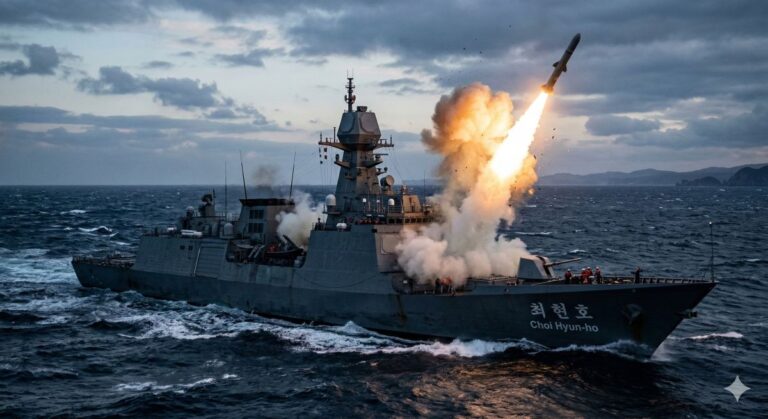
The Next Generation Corvette is 127.4 m long and 17.6 m wide, with a displacement of 4,950 t. Its top speed is 26 knots, and its crew consists of 11 officers and 139 sailors. It uses CODAG-CC propulsion, combining diesel engines and gas turbines, to drive two controllable-pitch propellers. Despite the corvette label, its displacement is in the frigate class.
Its armament comprises medium-range anti-ship missiles, 16 medium-range surface-to-air missiles (MRSAM) in two 8-cell vertical launchers, 324 mm torpedo tubes, a 76 mm gun, AK-630 close-in weapon systems and 12.7 mm remote-controlled machine guns. Its sensors are an electro-optical/infrared search and track system and the MFSTAR multifunction radar. According to Naval News, analysis of the design drawings indicates space for up to 16 anti-ship missiles.
A vertical launching system (VLS) stores missiles upright inside the hull and fires them upward. A close-in weapon system (CIWS) is a rapid-fire gun that intercepts incoming missiles and drones at the last moment. A multifunction radar handles both search and tracking with a single radar, and a controllable-pitch propeller adjusts thrust by changing the angle of its blades. CODAG refers to a propulsion method that uses diesel engines and gas turbines together.
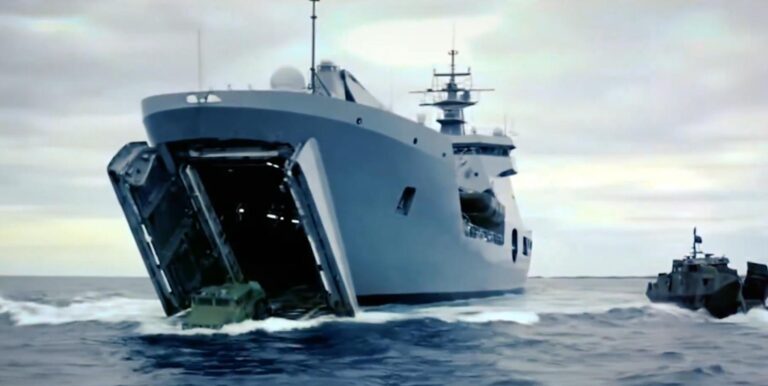
The contract comes at the same time as other major Indian Navy programs. According to naval trade publication Naval News, four next-generation destroyers of about 10,000 t were approved on October 26. Bidding is under way for four landing platform docks (LPD), with Spain’s Navantia teaming up with India’s Larsen & Toubro (L&T). That program received DAC approval in October 2025.
India has ordered eight frigate-class warships at once, centered on its state-owned shipyards. Since the two shipyards must begin deliveries in 2031, whether they keep to schedule is the next thing to watch. If the destroyer and landing ship programs are also finalized, the makeup of the Indian Navy’s surface fleet will change significantly. In a global naval shipbuilding report released last week, India ranked near the top, building 76,430 t of combatant ships in 2024–2025, behind China (636,208 t), the United States (270,509 t) and Russia (149,056 t).
For a sense of scale, simply adding up the displacement of the eight ships gives about 40,000 t (4,950 t × 8). If the four 10,000-ton-class destroyers are confirmed, roughly another 40,000 t would be added. However, the dollar value of the total contract, the value of Goa Shipyard’s share and whether the destroyer program has been officially approved have not yet been confirmed from original sources. Follow-up announcements from the Indian Ministry of Defence and the shipyards should fill in these details.
Related articles
- [Feature] Global naval shipbuilding up 50% in two years: China 636,000 t, US 271,000 t (in Korean)
- Hegseth lays out plan to strengthen Indo-Pacific alliances, but implementation remains unclear (in Korean)
This article was translated from the Korean edition of Science Monitor with AI assistance and reviewed by our editors.