Royal Navy tracks 3 Russian ships; Protector drone’s UK debut
The Royal Navy said on Nov. 2 that over 17 days from late September to mid-October it had tracked, in turn, a Russian intelligence-gathering ship, a frigate and a landing ship in waters around the United Kingdom. In addition to destroyers, patrol vessels and helicopters, the three operations saw the Royal Air Force (RAF) drone Protector RG1 fly its first operational mission in UK airspace.
Intelligence ship appears next to NATO exercise area
The first target was the Russian navy’s Vishnya-class intelligence-gathering ship Viktor Leonov. An intelligence-gathering ship is a vessel designed to collect an adversary’s radar and communications signals. A Royal Navy Merlin HM2 helicopter followed the ship around Scotland’s Outer Hebrides islands from Sept. 29 to Oct. 8. The helicopter, from Royal Naval Air Station Culdrose (RNAS Culdrose) in Cornwall, deployed to Glasgow Prestwick Airport to carry out the mission.
During the same period, the North Atlantic Treaty Organization (NATO) exercise Strike Warrior 26 was under way in these waters from Sept. 21 to Oct. 9. The Kyiv Independent reported that 2,000 personnel from six countries took part in the exercise. The Royal Navy said Leonov had “closely monitored” the exercise.
Captain James Hall, commanding officer of RNAS Culdrose, said the mission was “an important means of showing ourselves, our adversaries and the public.”
Frigate and landing ship escorting sanctioned cargo ships
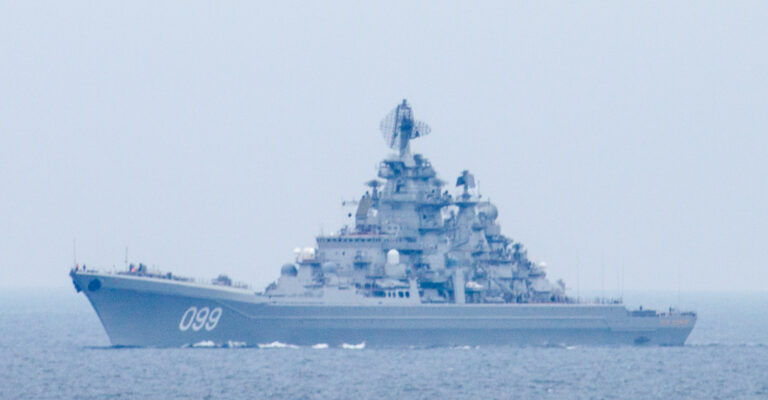
The other two operations took place in the English Channel. The Type 45 destroyer HMS Dauntless and the River-class patrol vessel HMS Tyne monitored the Russian frigate Neustrashimy from Oct. 1 to 14. The frigate passed through the Channel escorting sanctioned cargo ships.
Tyne then tracked the Ropucha-class landing ship Aleksandr Shabalin from Oct. 11 to 14. Shabalin led the cargo ship Energy-2 and the tug and supply vessel Proton toward the Baltic Sea, and a Royal Navy Wildcat HMA2 helicopter supported Tyne. The Kyiv Independent reported that the convoy included so-called “shadow fleet” vessels. The shadow fleet refers to ships that carry Russian oil and cargo while evading international sanctions.
The Royal Navy said that “Russia has been forced to deploy warships over the past three months to protect its illicit cargo.” Commander Neil Skinner, commanding officer of Dauntless, said the mission “provides reassurance to the UK and our allies.”
Protector drone’s first operational mission in UK airspace
A notable element of these operations is the drone. The RAF’s Protector RG1, a medium-altitude long-endurance (MALE) drone, is based on the MQ-9B. A MALE drone is an aircraft that stays aloft at high altitude for long periods and carries out surveillance missions. Flying from RAF Waddington, the Protector provided more than 10 hours of intelligence, surveillance and reconnaissance (ISR) support over the English Channel alongside ships and helicopters. This was the first time the Protector has been deployed operationally in UK airspace.
As Russian warships continue to escort sanctions-evading convoys directly, maritime sanctions enforcement off Europe’s coasts has gone beyond policing merchant ships and taken on the character of a navy-to-navy standoff. The Royal Navy said the number of Russian naval movements it monitored from January to July 2026 rose 25% from the same period a year earlier. With surveillance demand rising but the number of ships limited, attention is on whether surveillance systems combining helicopters and drones can ease the burden on ships. The pattern of Russian intelligence ships approaching every large NATO exercise also ties into discussions on exercise security and the protection of undersea infrastructure.
Sources: Royal Navy announcement (2026-11-02) · Coverage: ADS Advance, Kyiv Independent
Related articles
- Russian Navy cancels modernization of Kirov-class ‘Pyotr Velikiy’… the homework left by Nakhimov’s 12-year refit (in Korean)
- [Feature] Global naval shipbuilding up 50% in two years… China 636,000 t, US 271,000 t (in Korean)
- Royal Navy successfully tests quantum inertial navigation sensor in the Arctic (in Korean)
This article was translated from the Korean edition of Science Monitor with AI assistance and reviewed by our editors.