FuriosaAI Series D: State Funds Drive 3.8 Trillion Won Valuation
Half of the 820 billion won Series D comes from policy money: the National Growth Fund, KEXIM, KDB and others
Without hyperscalers, “20,000 units” for Korean procurement and private buyers? The upside and downside of jumping straight to 2nm
FuriosaAI, a South Korean AI chip fabless (design-only) startup, has raised a $620 million (about 820 billion won) Series D round, lifting its valuation to $2.9 billion (about 3.8 trillion won). That nearly quadruples its valuation in just over a year since its Series C bridge round in July 2025, which valued the company at $735 million.
A closer look at the details of the round, however, reveals both the structural limits of Korea’s AI chip ecosystem hidden behind the celebration and FuriosaAI’s precarious current position. We examined, issue by issue, why criticism of “artificially inflating valuations through state-directed finance” is being added to existing concerns over the “absence of commercial revenue” and “overreliance on the domestic market.”
| Category | Key Series D facts | Key risks |
| Funding structure | Of the $620 million total, 370 billion won ($280 million) from the National Growth Fund, the first direct investment by the Export-Import Bank of Korea, and an additional 30 billion won from Korea Development Bank | Deepening dependence on policy funds: The Financial Services Commission explicitly cited “overcoming funding difficulties” as the reason for support. Concerns that the valuation is propped up by the government-led “K-Nvidia” project rather than market self-sufficiency |
| Mass production and supply | 20,000 units of the second-generation chip “RNGD (Renegade)” this year, expanding to more than 40,000 in 2027. Adopted by Samsung SDS, LG, Upstage, Daum and others | Limits of domestic references: No orders from global hyperscalers. Aggressive advance production without confirmed revenue translates directly into the risk of large inventory write-downs |
| Technology and specs | 180W air-cooled PCIe card; claims twice the throughput per kilowatt (kW) of Nvidia’s RTX PRO 6000 | A misleading comparison: A simple performance-per-watt comparison with a workstation-class GPU rather than data center flagships (H200, B200). Unclear whether CUDA ecosystem switching costs can be overcome |
| Next-generation roadmap | Began developing a third-generation chip based on 2nm multi-die and HBM4/4E, in cooperation with Broadcom and others | Accelerating cash burn: Moving straight to an ultra-costly leading-edge process before second-generation monetization is proven. Possibility of a renewed liquidity crisis if further fundraising fails |
K-policy funds as an “anchor investment” to draw in private capital
Regulator admits “funding difficulties”… lining up “K-Nvidia” candidates distorts market logic
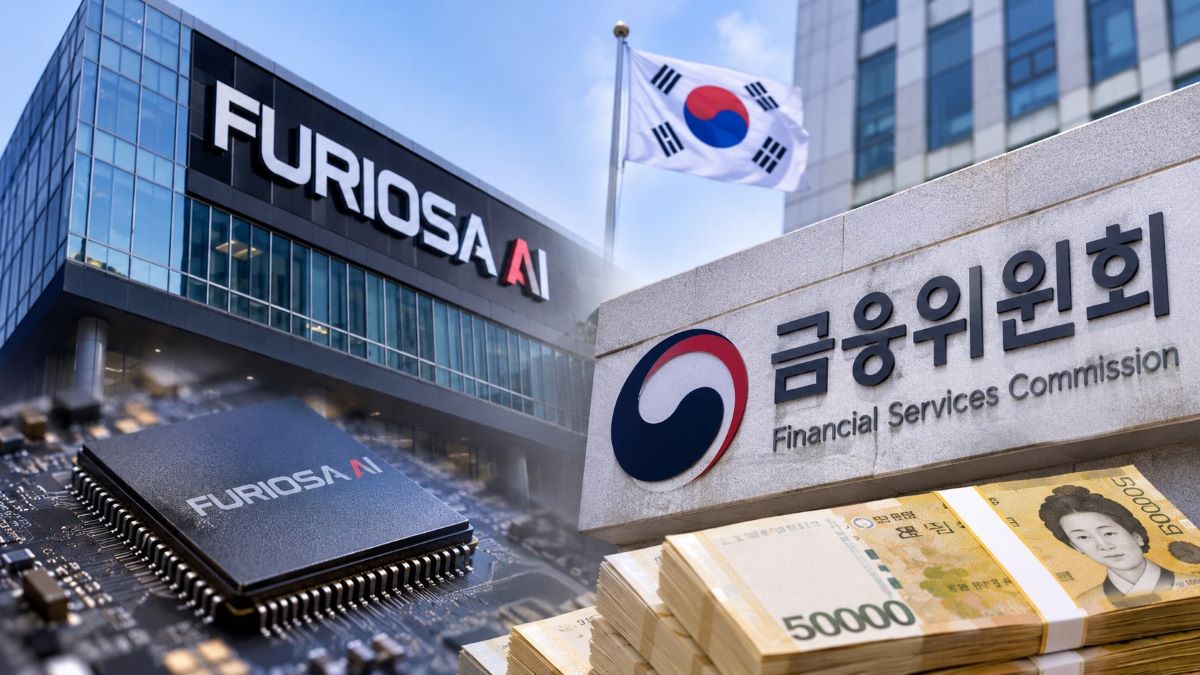
According to authorities, the largest investor in the round was the government-led “National Growth Fund (Advanced Strategic Industries Fund),” which alone poured in a hefty 370 billion won (about $280 million). The Export-Import Bank of Korea, a state-run export credit agency, took part in what is its first direct investment in a startup since its founding, and existing shareholder Korea Development Bank (KDB), a state-owned policy lender, added 30 billion won. Nearly half of the total raised came from state and policy finance.
Notable is the explanation the Financial Services Commission (FSC), Korea’s top financial regulator, gave when it approved the funding in May. The FSC stated that it was supporting FuriosaAI “so it can overcome funding difficulties and compete for global leadership without a capital gap.” In effect, the government itself admitted that after FuriosaAI rejected Meta’s acquisition offer, private capital markets alone could hardly cover the enormous costs of chip development and mass production.
Earlier, in March, the government injected 300 billion won in policy finance, including 250 billion won from the National Growth Fund, into rival Rebellions, lifting its valuation to $2.34 billion. This approach of artificially nurturing “K-Nvidia” candidates by mobilizing household savings and policy finance under a 150 trillion won, five-year plan is having the adverse effect of providing a “greenhouse of state-directed money” to startups that should be proving their commercial viability in the unforgiving global Big Tech market.
Producing 20,000 units without “confirmed orders,” and a “frog in a well” customer base
FuriosaAI said it will produce 20,000 units this year of RNGD (Renegade), its second-generation inference chip that entered mass production in January, and that it has secured foundry and memory capacity to more than double volume (to more than 40,000 units) in 2027. Overseas investors such as Infinitum and Cisco Investments are on the investor list, but the size of their investments was not disclosed. There are no hyperscalers to buy the chips in volume in the global market, and demand remains confined to Korea.
Adopters are effectively limited to the homegrown IT ecosystem: Samsung SDS, LG AI Research, Upstage and Daum (a Korean web portal). The company is following the same path as its first-generation chip, Warboy, which secured only domestic cloud and public-sector references without generating substantial large-scale revenue. Although a “K-procurement market” (Korean public procurement) has opened to create demand following the government-led fundraising, the lack of large-scale supply contracts with hyperscalers (large cloud operators) in North America and Europe is a critical limitation. That is why concerns are being raised that preemptively churning out tens of thousands of chips a year is close to a gamble that could come back as massive “bad inventory.” The very fact that Naver Ventures, the venture arm of Korean internet company Naver, remarked that “our role is to help with growth in the North American market” suggests the company has yet to achieve a meaningful commercial breakthrough in the global market.
“Twice the RTX PRO 6000”? A benchmark illusion
Subtle sleight of hand can also be detected in the way the company stresses its technological edge. FuriosaAI claims that because RNGD comes as a 180W air-cooled card, existing enterprise server racks need no retrofitting, and that it can serve twice as many users per kilowatt (kW) as Nvidia’s RTX PRO 6000.
However, Nvidia’s flagship lineup, which dominates the global AI data center inference market, is moving beyond the H100 and H200 to the Blackwell (B200) architecture. Touting “twice the performance per watt” against the RTX PRO series, a professional visualization and workstation lineup rather than a flagship data center accelerator, is a weak metric for persuading global enterprise customers. It overlooks the fact that companies line up to buy Nvidia’s high-power, liquid-cooled servers, even at the cost of retrofitting their facilities, not for raw power efficiency but for the stability of its software ecosystem (CUDA) and productivity from a total cost of ownership (TCO) perspective.
Above all, the figures disclosed so far are based on the company’s own tests. Results vary with model size and precision, batch size, input and output token lengths, latency and the level of software optimization. Independent third-party testing and TCO data from real customer environments are also needed.
Another barrier is the software ecosystem. Nvidia has built up development and operating environments such as CUDA and TensorRT over many years. Even if FuriosaAI supports major software environments such as PyTorch and vLLM, whether it has secured enough developer convenience and operational stability to replace existing GPU infrastructure is a separate question.
Nvidia expands dedicated inference accelerators… competition shifts to the system level
The market the company must compete in is changing quickly. Demand for specialized accelerators is growing as the AI inference market expands, but Nvidia is not defending the market with GPUs alone either.
In August 2026, Nvidia announced that it had moved the Groq 3 LPX into full production. The product is a low-latency inference accelerator that pairs with the Vera Rubin platform. It targets workloads such as AI agents, where repeated inference and fast token generation matter. Nebius was also announced as the first cloud provider to adopt it.
This shows that the specialized inference chip market is not the preserve of independent startups. Incumbent GPU companies are also combining specialized accelerators with their own platforms to improve token generation speed and power efficiency.
Domestic rival Rebellions is also expanding its systems business. In March 2026 it announced a $400 million pre-IPO investment, and its valuation at the time was reported at about $2.34 billion. Centered on the Rebel100, it is developing data center inference systems such as RebelRack and RebelPOD and pursuing overseas markets including the U.S., Japan and Saudi Arabia.
Competition between FuriosaAI and Rebellions, too, is not limited to the computing performance of individual chips. Server integration, software compatibility, supply stability, customer support and actual operating cost per token are becoming the factors that determine market share.
For these new players to compete with Nvidia’s ecosystem, they must offer not only product performance but also an economic reason for customers to replace their existing infrastructure.
Jumping straight to “2nm and HBM4” before proving profitability… fears of pouring water into a bottomless jar
The bigger risk lies in the next-generation roadmap. FuriosaAI has declared that, in cooperation with Broadcom and others, it will develop a third-generation chip aimed at next-generation agentic AI models based on a 2-nanometer (nm) multi-die process and HBM4/4E memory.
The next-generation design targets agentic AI and large-scale inference clusters. In environments where multiple AI agents call models in succession, memory bandwidth, data movement and chip-to-chip communication become important, not just computing performance. That is why the company seeks to combine a multi-die structure with high-bandwidth memory.
But a development roadmap and production validation are different things. 2nm design, HBM4/4E integration, advanced packaging, chip-to-chip interconnects and software optimization must all be completed before it becomes an actual product. Tape-out, yield validation, customer evaluation and the mass production schedule also remain.
The partnership with Broadcom amounts only to technical capability and a sharing of development risk. A joint development announcement alone does not guarantee successful mass production of the next-generation chip or the winning of global customers. Disclosure of specifics such as how development costs will be borne, the division of technical work, IP rights and responsibility for mass production is also limited.
In the chip industry, a tape-out (handing a completed design to a foundry) on a leading-edge 2nm process and the adoption of HBM4 are an ultra-high-cost domain where hundreds of billions of won evaporate on securing design intellectual property (IP) and making masks alone. With it still unclear whether the second-generation RNGD will even break even, let alone recoup its investment (ROI), heading straight to the most expensive, latest process means the 820 billion won raised this time will inevitably be depleted quickly as well.
“K-anchor funding” as seed money: between risk and opportunity
Viewed coolly, the essence of this investment is that it is a round “anchored by Korea’s state fund.” Although some foreign capital joined, such as Infinitum, which had invested in Groq, it is a valuation that would have been impossible had the state not laid down a 400 billion won safety net.
The extent to which policy finance drew in private investment and brought forward the commercialization of Korean AI chips could count as an industrial policy achievement. Conversely, if funds poured into technology development and mass production fail to secure recurring revenue and profitability, the investment risk to public funds grows.
A valuation of 3.8 trillion won is sustainable only if it is backed by a transparent financial report card of confirmed revenue and operating profit, going beyond proof-of-concept (PoC) technology validation. If a vicious cycle of burning money on third-generation chip development without real cash generation from the second-generation chip repeats itself, this Series D round risks going down as the most expensive “state-directed funding” failure in Korean venture history.
Meanwhile, overseas investors participating in the Series D include Infinitum, Cisco Investments, Jericho Capital, NeoFort Holding, Worldline Capital and Singapore-based QUDA Capital.
This article was translated from the Korean edition of Science Monitor with AI assistance and reviewed by our editors.