China’s Jiuzhang 4.0 detects 3,050 photons: meaning and limits
China’s photonic quantum computer Jiuzhang 4.0 wins WIC Award
Jiuzhang (九章) 4.0, a photonic quantum computer built by researchers at the University of Science and Technology of China (USTC), has been named among the 20 winners of the 2026 World Internet Conference (WIC) Leading Science and Technology Awards. The award ceremony was held on Monday in Wuzhen, Zhejiang Province.
More noteworthy than the award itself are the scale of the experiment described in the device’s May paper in Nature and the debate surrounding its claims.
According to the conference organizers, more than 430 entries from 43 countries and regions were submitted this year. The 20 winners are divided into two in basic research, 10 in key technologies and eight in engineering and development. Besides Jiuzhang 4.0, the winners include a space-based quantum information optical transmission technology and an AI agent platform for intelligent vehicles. The judging was carried out by the organizers and is a separate process from independent academic verification.
The Jiuzhang series began in 2020, when the first model detected 76 photons. Version 2.0 then detected 113 and 3.0 detected 255, while 4.0 detected up to 3,050 photons in a single run — more than ten times as many as the previous generation. According to The Quantum Insider, the series is led by the research group of Professor Pan Jianwei, and USTC Professor Lu Chaoyang explained the research when the May paper was presented.
Gaussian boson sampling
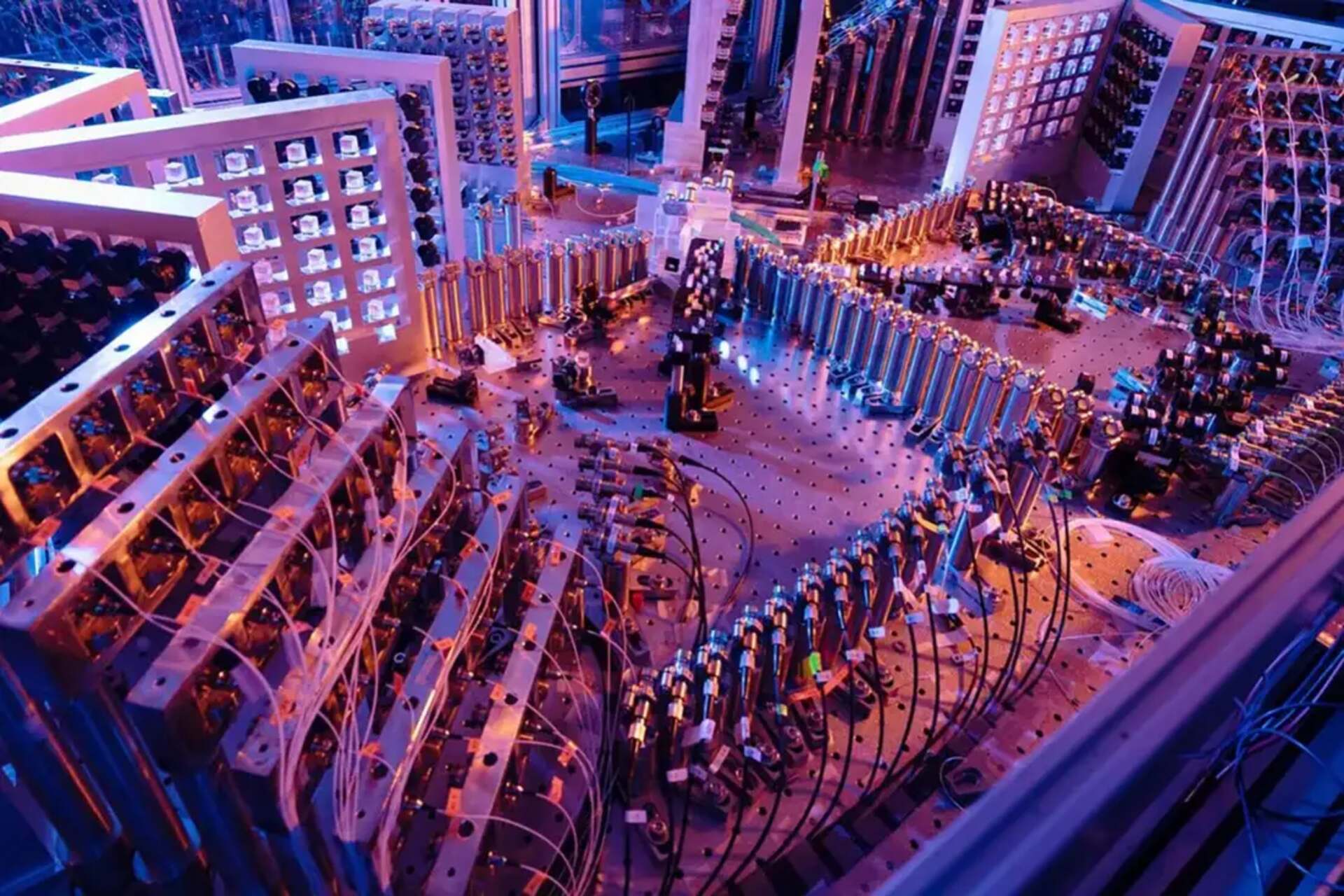
Jiuzhang is not a general-purpose quantum computer but a dedicated device that solves one specific problem called Gaussian boson sampling. It sends squeezed light (light in which quantum noise has been reduced in one direction) into an optical circuit made up of many paths (modes), records how many photons are detected at each exit, and draws samples from that probability distribution. The premise of the experiment is that the larger the circuit becomes, the harder it is for a classical computer to mimic the same distribution.
The paper published in Nature is titled “Gaussian boson sampling with 1,024 squeezed states over 8,176 modes.” It integrated 1,024 high-efficiency squeezed light sources. According to the Chinese Academy of Sciences(CAS), the team newly built high-efficiency optical parametric oscillator light sources and a spatiotemporally hybrid-encoded interferometer. The researchers estimated that producing the single most complex sample takes about 25 microseconds, whereas El Capitan, the world’s most powerful supercomputer, at Lawrence Livermore National Laboratory in the United States, would need more than 1042 years. That amounts to a claim of being more than 1054 times faster than the supercomputer. These are the researchers’ own estimates, not independently reproduced figures.
The debate: classical-algorithm rebuttals and limits
Boson sampling experiments have always raised the question of whether classical computers can catch up. A 2024 study by the University of Chicago and Argonne National Laboratory, published in Nature Physics, argued that classical methods can reproduce boson sampling results better than the experiments. The Jiuzhang 4.0 team counters that even with that method, El Capitan would take about 1042 years. As long as the two claims conflict, terms such as “quantum advantage” should be used together with the experimental conditions.
Boson sampling has no known commercial use. Professor Lu Chaoyang said the technology could lead to large-scale three-dimensional cluster states (resource states made by entangling many photons) and become the hardware for fault-tolerant photonic quantum computers. However, this is an outlook presented by the researchers, not a capability that has been realized yet.
Industrial and policy implications, and remaining challenges
The award means that Jiuzhang 4.0 is one of 20 entries selected by the conference. It is the result of the organizers’ judging; technical validity depends on the paper and follow-up verification.
Three challenges remain. First, whether boson sampling can be linked to practical problems. Second, independent reproduction to settle whether classical algorithms can catch up with the experiment. Third, whether the path the researchers have put forward, toward 3D cluster states and error-corrected photonic quantum computers, is actually proven. Until these three are resolved, it is more accurate to treat the Jiuzhang series as an example of a quantum advantage demonstration.
The rise in detected photons from 255 to 3,050 shows how fast photonic quantum hardware is scaling. At the same time, it should be viewed alongside the continuing competition with classical simulation and the absence of practical applications.
Related articles
- China unveils world’s first “dual-core” quantum computer (in Korean)
- China’s $17.5 billion quantum project investment… global race for quantum supremacy intensifies (in Korean)
- Photonic quantum computer outperforms in machine learning (in Korean)