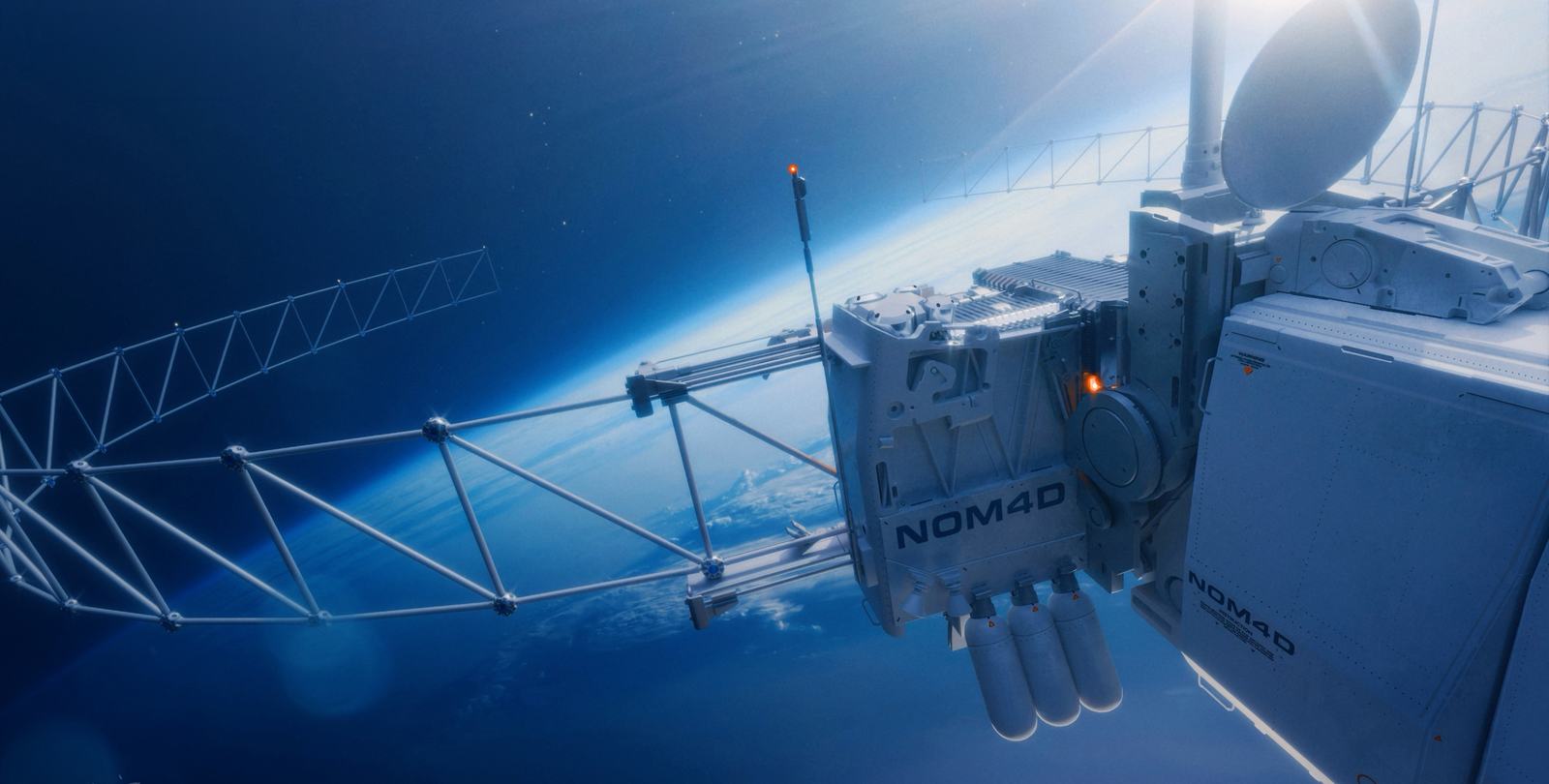
Caltech’s ASTRA Robot Builds Antenna Frame in Orbit on Its Own
Caltech team achieves first-ever autonomous robotic assembly of a space structure’s framework
A key milestone for DARPA’s NOM4D project…taking on giant structures in space
Think of the James Webb Space Telescope (JWST), the largest eye humanity has ever launched into space. To send its 6.5-meter-wide mirror into space, scientists had to fold the enormous structure dozens of times, origami-style, and squeeze it into the cramped fairing (payload cover) of an Ariane 5 rocket. What if we needed to put a solar power plant or deep-space antenna hundreds of meters, or even several kilometers, across into orbit? No matter how sophisticated the origami, it cannot overcome the inherent limit of a rocket’s physical volume.
An event that could put an end to this long-standing engineering dilemma has taken place in low Earth orbit, several hundred kilometers above the planet. Without a human hand or real-time piloting, a structure was assembled directly in space by robotic power alone. A research team led by Professor Sergio Pellegrino at the California Institute of Technology (Caltech) announced on Nov. 6, local time, that its autonomous assembly system ASTRA had successfully built the framework of a reflector antenna on its own in low Earth orbit. It is the first time in human history that a structure has been autonomously built in orbit without a risky spacewalk (EVA) by astronauts.
The story of this small miracle goes back to the early morning of March 30. SpaceX’s Transporter-16 rocket, which lifted off from Vandenberg Space Force Base in California, carried Vigoride 7, an orbital service vehicle from space transportation company Momentus. ASTRA secured its ticket to low Earth orbit as one of the 10 payloads aboard that spacecraft. About the size of a box measuring just over 1 meter in width, depth and height, ASTRA safely withstood the tremendous shock and vibration of launch. Packed tightly inside the small box were a robotic manipulator arm, two truss bays pre-assembled on the ground, and, in motorized dispensers, the struts (carbon composite tubes) and joint parts needed to build the rest of the structure.
Jaden Suh joined the project from its early days as a Caltech postdoctoral researcher and is now an assistant professor at the University of Texas at Austin (UT Austin). He has harbored a special curiosity about space structures since childhood. He witnessed a system that brought together ideas he had designed and devised unfold in actual orbit.
Once ASTRA had safely settled into orbit, the ground team began sending commands to ASTRA’s onboard computer via the Vigoride spacecraft. First, the fixtures (launch restraints) that had held the parts steady during launch were released. Next, the two pre-assembled bays stowed inside the truss builder were pushed out into space, and finally, work began on building the third bay on site.
ASTRA’s overall mission is to join a total of 11 identical truss sections, or bays, like Lego blocks to complete a circular antenna frame 1.4 meters in diameter. Each bay is made as the main manipulator robot moves, picking up struts and joints one by one from the motorized dispensers and fitting them into precise positions on an assembly plate. Once the framework is assembled, the manipulator attaches perforated films with dense, mesh-like holes to the truss. These films are pulled in opposite directions by springs, forming a two-layer reflective cable net under taut tension (prestress).
The reflective material used here was jointly invented by the Caltech team and Professor Igor Bargatin’s team at the University of Pennsylvania. Unlike the braided metal mesh commonly used in conventional folding space antennas, it can maintain a taut curved surface with very little tension, allowing the entire support structure to be designed much lighter. Once one section is prepared and its net attached, the finished bay is pushed out toward space and the next bay is built in its place, in a repeating sequence.
Of course, the past six months of orbital experiments did not go as smoothly as the blueprints. Former Caltech systems engineer Charles Sommer [check spelling], research engineer Alan Truong [check spelling] and graduate student Tara Venkatadri [check spelling] sent assembly commands into space, then downloaded the photos taken by the 11 cameras on the payload and compared the results one by one. In the process, numerous unexpected problems surfaced. Professor Jaden Suh explained that in the space environment, which is completely different from the ground, small unexpected variables always pop up, and that is exactly why proof-of-concept (PoC) testing is essential.
What proved decisive in overcoming the unexpected hurdles in space was an identical ground replica built in the Caltech lab in Pasadena, the “Flight Spare Twin.” The ground team could communicate with the spacecraft only 7 to 8 times a day, when a communication window of barely 15 minutes opened. As Charles Sommer explained, whenever a problem was found in space, the team immediately rushed to the lab and reproduced the same error on the twin robot on the ground. After testing several alternatives to find a solution, they sent a workaround command to ASTRA in space at the next contact window, a painstaking process that was repeated over and over.
Behind this success lies the bold vision of the NOM4D (Novel Orbital and Moon Manufacturing, Materials and Mass-efficient Design) program, pursued since 2022 by the U.S. Defense Advanced Research Projects Agency (DARPA). Until now, every satellite and space structure has had to be designed heavier than necessary to withstand the harsh loads of launch. NOM4D’s idea is to launch raw materials and parts densely packed, then assemble them directly in calm orbit to build structures that are both paper-light and enormous. Caltech’s ASTRA is one of only two projects in the program to reach Phase 3, the actual in-orbit demonstration stage. DARPA program manager Andrew Detor said the demonstration will open an era of efficiently building infrastructure in space on a scale that current technology could never reach.
With its official mission set to end in December, ASTRA is not expected to complete all 11 bays due to time constraints. But autonomously assembling the third bay in orbit alone has sufficiently proven the feasibility of in-orbit autonomous assembly. Based on lessons learned from this demonstration, the team plans to further simplify and refine future designs.
Professor Pellegrino says that once you reach the limit of what can be built on the ground and folded for launch, you ultimately have no choice but to consider building directly in space. As he puts it, this technology holds the key to reshaping the space industry, from astronomy and astrophysics observation instruments to high-performance communication antennas and the construction of giant solar arrays for space-based solar power. The era of folding human imagination to fit the size of a rocket is over. How long until the little robot carpenters sent into space hammer together kilometer-scale power plants and giant telescopes high above the Earth?
This article was translated from the Korean edition of Science Monitor with AI assistance and reviewed by our editors.