













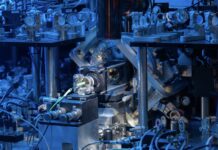









Sandia National Laboratories has successfully created its inaugural batch of an advanced ion trap named the Enchilada Trap, a critical component in specific quantum computers. This innovative device opens the door for scientists to construct more potent machines, advancing the experimental yet potentially transformative realm of quantum computing.
Furthermore, along with the traps utilized at Sandia, a batch of traps was dispatched to Duke University in July for comprehensive analysis and testing. Duke University and Sandia are collaborative research partners within the Quantum Systems Accelerator, one of the five U.S. National Quantum Information Science Research Centers.
An ion trap, a microchip capable of holding electrically charged atoms or ions, is the core principle. A quantum computer can execute more intricate algorithms with an increased number of trapped ions, also known as qubits.
The Enchilada Trap has the capability to accommodate and transfer up to 200 qubits, a notable improvement from Sandia’s previous model, the Roadrunner Trap, which had a maximum capacity of 32 qubits. Both iterations are produced at Sandia’s Microsystems Engineering, Science, and Applications fabrication facility.
According to Daniel Stick, a distinguished scientist at Sandia and a leading researcher in the Quantum Systems Accelerator, a quantum computer with up to 200 qubits and existing error rates might not surpass the capabilities of a traditional computer for solving practical problems. Nevertheless, this advancement enables researchers to test an architecture with a multitude of qubits that could potentially support more intricate quantum algorithms for fields such as physics, chemistry, data science, materials science, and beyond.
“We are providing the field of quantum computing with the necessary space to evolve and explore larger machines and more intricate programming,” Daniel stated.
Sandia’s Approach to Innovation
Over the course of two decades, Sandia has been engaged in the research, development, and testing of ion traps. To surmount a series of design challenges, the team combined their institutional knowledge with cutting-edge innovations.
A primary challenge was to create a structure capable of accommodating more ions and facilitating their rearrangement for complex computations. The team devised a network of electrodes that branches out in a manner reminiscent of a family tree or a tournament bracket. Each slender branch serves as a storage and transport location for ions.
This branching architecture was previously experimented with in earlier trap versions. Stick believes that the branching design is currently the optimal solution for rearranging trapped ion qubits and anticipates that even larger future iterations of the trap will adopt a similar design.
Another critical concern was the management of electrical power dissipation within the Enchilada Trap. Excessive heat generation, which could lead to heightened outgassing from surfaces, an increased risk of electrical breakdown, and elevated levels of electrical field noise, needed to be addressed. To tackle this, production specialists engineered new microscopic features to decrease the capacitance of specific electrodes.
Zach Meinelt, the lead integrator for the project at Sandia, emphasized the forward-looking approach of their team. He stated, “Our team consistently gazes into the future, collaborating with scientists and engineers to understand the forthcoming technology, features, and performance enhancements they will require. Subsequently, we craft and produce traps to meet these demands and continuously seek avenues for further enhancements.”